

While it was not part of our plans originally, we decided to force Singapore into our itinerary, and the main reason for that was that we wanted to see what life could look like in the world’s cleanest, most accessible country with the finest public transport. JK, it's because Niki wanted to eat some fictional dish called SINGAPURI FRIED RICE.
Let's get the fun stuff out of the way. As soon as we landed in Singapore, I got two shocks at the same time. Firsly, immigrating into the country was by far the smoothest experience that I have ever had. Completely automated and no need to convince a human behind the counter that you are not a criminal while sweating profusely, acting 100% like a criminal. 2nd shock followed shortly after- as soon as we stood in one of the 5,000 nearly empty lines to cross the automatic gates, some random lady (likely a local) started yelling and screaming at Niki, saying, "How could you stand in this line??? This was my line!! You have crossed a line!!" Or something along those lines. After a moment of frustration, I reminded Niki that casual racism is just another sign of a people being too comfy to have any real issues, and that we should just treat this incident like a fond little reminder of the Vaterland. The last time I had experienced clear racism was in Thailand, when a curry puff lady absolutely refused to sell curry puffs to me. (The absurd irony of that episode is not lost on me 🤦♀️)
We took the train from the airport, where I got my third shocker: the Tamil being spoken everywhere. This one is entirely on me, guys. I knew very little about Singapore before arriving here. I mean from my food research I had some idea that one finds great food from all corners of Asia, but I had really overlooked true extent of the influence. Sorry Doobie I might have skipped some bits of your deep dive during my research 😶🌫️
So apparently, Singapore runs on four official languages: English, Mandarin, Malay, and Tamil. Unlike Berlin or London, this place isn't just a metaphorical melting pot where people naturally mingle; it was engineered that way. Back under British rule, neighborhoods were strictly segregated by race, which (as per usual program) eventually exploded into violent race riots in the '60s. When Singapore gained independence in 1965, the government stepped in with a pretty heavy rulebook. They made English the neutral common language so no single group dominated, and slapped mandatory ethnic quotas on public housing blocks so neighbors were forced to live side-by-side. Add strict laws against hate speech, and you get this surreal, highly structured Multikulti ecosystem. Which explains hearing pure Tamil on a train rolling past a landscape of modern skyscrapers.
The said train brought us pretty quickly to our capsule in a boutique capsule hotel. This concept of sleeping pods was invented by the Japanese in 1970, designed to give exhausted salarymen a cheap place to sleep when they missed their last late-night train home. Thanks to those, now non-salaried people can afford a few nights in the world’s most expensive travel destination. These hotels with their claustrophobic rooms full of tiny pods and common shared spaces like bathrooms and kitchens, it's not an experience for the faint of heart, and I say this because I am extremely privileged. I saw entire families of grown people living in these pods (not traveling and staying a few nights, living, because that may be all they can afford for some reason).
It's okay, we didn’t mind too much, because we had way too much to look forward to here, as we were once again in the Michelin/ Mark Wiens territory and I came prepared for the new mission 😀

Before I start talking about the star of this show, the food, let me introduce you to the concept of hawker centers. Long before Singapore became the ultra-modern city it is today, street hawkers roamed the island selling cheap, homemade comfort food off pushcarts and wooden poles to hungry, hardworking locals. While the chaotic street stalls served delicious meals from Chinese, Malay, and Indian traditions, they also caused massive sanitation and traffic issues across the growing nation. To clean up the streets without losing these beloved food traditions, the government gathered all the independent vendors into organized, covered venues with strict hygiene standards, clean running water, and proper facilities throughout the 1970s and 80s. These bustling open-air spaces quickly evolved into the heart of local culture. Budget-friendly community dining halls where people from all walks of life gather over incredible food, eventually earning a proud spot on UNESCO’s Intangible Cultural Heritage list. This is the main reason to visit Singapore, and likely the only place where you can have the best Nasi Lemak outside Malaysia right next to the best Hainanese chicken rice outside of Hainan.
So once again, on this particular week, for the first time since Bangkok, we ate like kings. What was that? You thoroughly enjoyed my insane deep dive into the foods that left a mark on us in Bangkok and are dying for another round of the same? Say no more, my friends, I live to entertain you:
Coffee, Kaya Toast, and Curry Puffs (Heap Seng Leong Coffeeshop)
Stepping into Heap Seng Leong = stepping directly onto a movie set from 1974. The main attraction here is their iconic Kopi Gu You- a cup of dark, robust coffee served with a thick slab of yellow butter slowly melting right into the brew. But we all know I don’t love coffee (unless its nandumari's coffee), and butter is a no-go for Niki. So Niki ordered regular coffee and I had the charcoal-grilled kaya butter toast and a potato curry puff (from the shop next door) that more than redeemed my traumatizing curry puff rejection in Thailand. You know what curry puffs taste like? They taste like samosas before Delhi murdered samosa recipes for everyone. Please, guys, if your samosas need paneer, kishmish, and kajus, do us all a favor and go eat something else. Anyway, back at the coffee shop, watching the slightly irritated ancient toothless uncle with his collection of coffee-brewing gear from when it was originally invented- brew coffee over open flames is worth the trip alone.
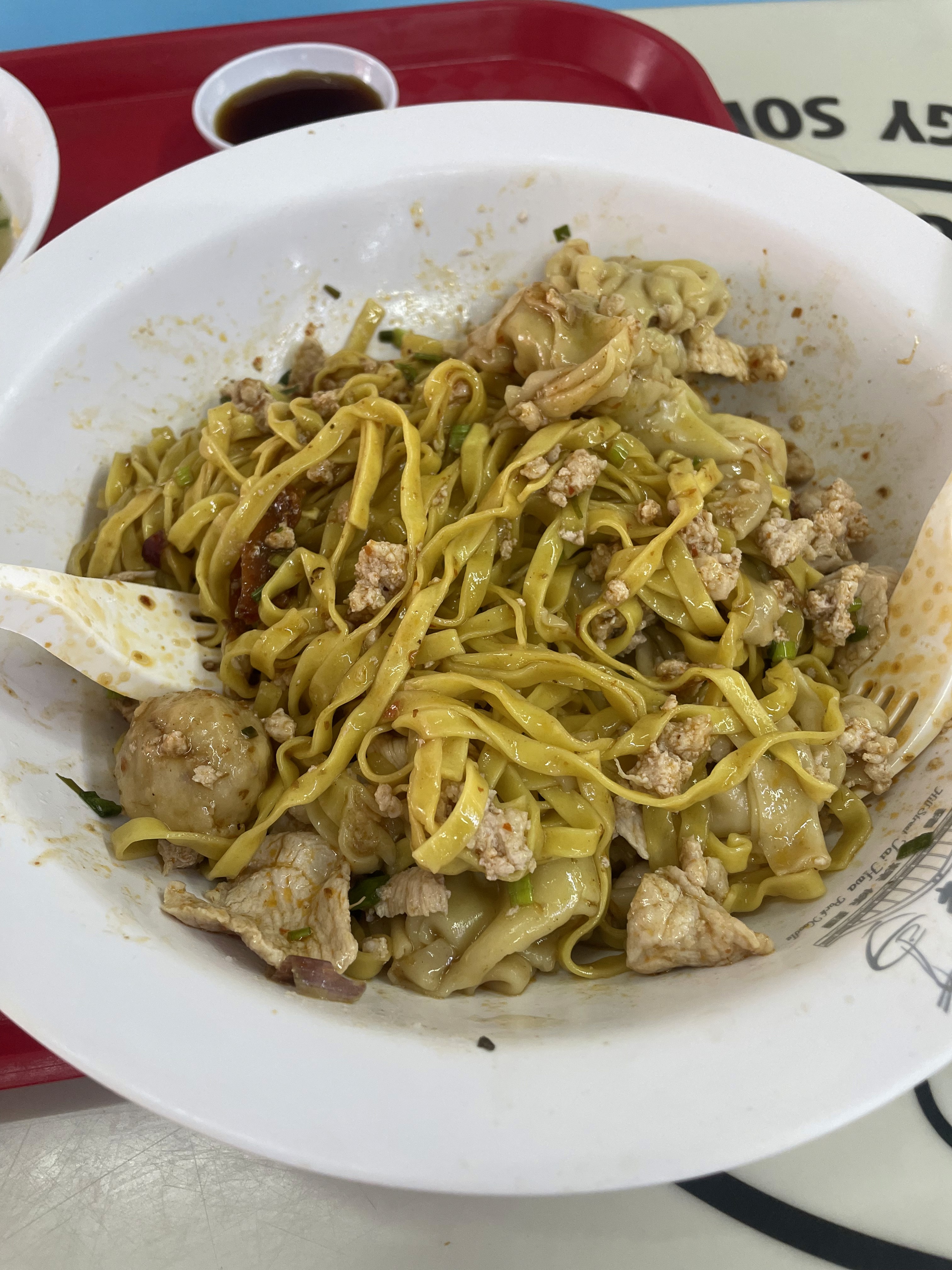
Bak Chor Mee (BCM) (Hill Street Tai Hwa)
This legendary stall was founded in the 1930s by Tang Joon Teo, but it is his son, Tang Chay Seng- the 2nd-generation uncle running the show- who took over in the 1960s and eventually snagged a Michelin star in 2016. We stood in line for nearly 50 minutes under the humid Singapore heat, watching the team bowl out portion after portion with laser focus. In the queue I spoke to a local middle-aged aunty who has been coming here since she was a literal child. BCM (minced pork noodles) is pure perfection: springy flat egg noodles tossed in a sharp, savory black vinegar and chili sauce, loaded with…more stuff 🤫. The tangy vinegar hits you first, followed by deep flavors that do a decent job of nearly ruining all future noodle experiences for you. Was it worth burning more than an hour of our precious Singapore itinerary? 10/10, will do again.
Wontons, Xiao Long Bao, and Sichuan Dan Dan Noodles (Zhong Guo La Mian Xiao Long Bao)
You cannot visit Singapore without committing to at least one completely unhinged dumpling crawl. We were very much on time for this one-reaching within the first 5 mins of the shop opening and narrowly defeating around 500 people in the queue. This little shop is run by a husband and wife (and now also assisted by their son) from Sichuan who have been folding dumplings with surgical speed for decades. We ordered like people who hadn't eaten in three days: a steamer basket of Xiao Long Bao bursting with scalding, savory broth that will absolutely scorch your tongue if you get impatient, silky pork-and-shrimp wontons swimming in a puddle of lethal chili oil and black vinegar, and a bowl of hand-pulled Sichuan Dan Dan noodles. That creamy, nutty sesame paste mixed with chili oil and numbing Sichuan peppercorns hits your brain in a way that should probably be illegal. It was all gone in less than 5 minutes.

Assortment of Indian Food (Jom Makan, Gandhi, and Nasi Kandar)
Contrary to what I am assuming is popular belief by now, I still love Indian food a lot. It's terrible for my gut health and also general health (i mean so is the 100 liters of chilli oil I am about to drink in China), but 100% worth the bad sleep occasionally. Singapore serves some of the finest Indian food outside of India (ok London, you are still in the loop, but on thin ice). First up was Gandhi Restaurant in Little India, which was almost (ALMOST) comparable to Nagarjuna, with the banana leaves, endless helpings of sambhar rice, and a pretty solid mutton curry. On a different evening, we hit Jom Makan for some paratha and mutton curry- this is pretty close to our Malabar Parota (or pratas, as they call them) crushed up and served alongside the most mellow mutton curry. Next was Nasi Kandar- this place was a short bus ride from our capsule, so we ended up there two nights in a row. I have really never had naan this good, many times even in India. Their tandoor items could give many Delhi mughlai restaurants a run for their money, and the chili chicken (look away, boys and girls from Delhi) was better than the one from the Vasant Kunj hawkers.

Char Kway Teow (CKT) (Hill Street Fried Kway Teow)
Next up was CKT (fried flat rice noodles) from Hill Street Fried Kway Teow in Bedok. The uncle running this wok is an absolute legend who looks like he has been frying noodles for centuries (likely on this exact wok), and honestly, watching him toss heavy woks over roaring flames at his age is an athletic feat. The dish relies heavily on wok hei- that smoky, charred essence you can only get from high-heat wok frying. He tosses flat rice noodles with dark soy sauce, bean sprouts, eggs, Chinese sausage, and in this case, some cockles. It really doesn’t look like much, but it's greasy, smoky, heavy, and probably the best hangover cure meal.

Nasi Lemak (SpicyWife)
Only for my best, most loyal readers, I have saved my most mind-boggling bite from Singapore for the very end of the list. My dears, have you had fried chicken? No, you have not, unless you have had the best Nasi Lemak from SpicyWife in Amoy Street Food Centre. This Malaysian-style stall serves a fried chicken leg (Ayam Goreng Berempah) that is so massive it barely fits on the plate, encrusted with an insanely crunchy, fragrant herb crust made from lemongrass, turmeric, and ginger, paired with coconut rice and a fiery sambal. Watching the guy behind the counter dish out plate after plate with almost octopus-like speed and precision was fascinating to watch!
I remember sitting in this hawker center with my beautiful plate of Nasi Lemak, sharing the table with a local finance-job-type uncle having his lunch, probably in the middle of a rather hectic workweek. I was so excited mid-meal that I turned to him and said, "This is the best meal I have had in Singapore 😁" He looked at me, looked at my plate, took a deep breath, and said, "Yes, but it's very, very unhealthy," and went back to eating his toddler portion of soup. Okay, sir?? Regardless, this single dish ALMOST ruined all other fried chickens for me forever (not you, Ayam Goreng from my train ride to Yogyakarta in 2023, I still dream of you sometimes). If you only eat one thing from this entire list, let it be this one.

As you can tell, the best food in Singapore comes from all the countries that built it. But between meals, we still hit most of the classic tourist stops like Gardens by the Bay, the Merlion (I don’t get it one bit: why is this place so extremely hyped again?? And also, did you know that the Merlion 1000% has a cavity in its front teeth), the Supertrees, and that ship-on-a-building (did you know that the ship was put there as an afterthought because feng shui says three buildings standing like that look like incense sticks at a funeral, making it an immediate feng shui disaster?).
Here are the things I noticed that make Singapore the most unique spot on earth:
Lungis everywhere: Seeing uncles casually rocking lungis on the street while standing next to Asian baddies in the hottest streetwear was easily one of the wildest, most confusing cultural contrasts I came across.
A love letter to the English past: Coming from India, where we kept the language, the trains, and the legal system, but actively stripped away the colonial names and statues out of spite, it was wild to see Singapore embrace theirs. They didn't rename a thing. Sir Stamford Raffles still has statues everywhere, and street names are straight out of London. Why? Because the guy basically created Singapore out of thin air as a trading port, so it wasn't anything like India's colonial past.
Accessibility heaven: The transit system, flat pavements, ramps, and seamless elevators make this city an absolute dream to navigate for me.
Tailors: Because of mandatory military service, there is a whole hyper-specific tailoring industry dedicated to young soldiers needing quick uniform fittings. I actually saw an Indian-Singaporean family at a tailor shop with their two teenage sons getting their uniforms stitched, which was such a cool, real-life slice of local culture to stumble across.
Chickens on the run: Wild chickens casually roaming around housing estates, traffic junctions, and parks like they own the joint. Turns out they are native Red Junglefowl, protected by law, and living their absolute best, predator-free lives alongside modern skyscrapers.
Urban greenery on steroids: The city is practically a (very manicured) jungle with skyscrapers dropped into it. Massive park connectors, roof gardens, and tree-lined walkways across every neighborhood. You forget you are in a major financial hub.
Choping: Kleenex packets serve a dual function here in Singapore. Apart from the obvious, they are also used to reserve tables at food courts or public eating areas, a common practice called “choping.” The more daring “chopers” use their staff IDs, keys, and even mobile phones to reserve their seats while they are off purchasing food. If that isn’t a testament to how safe the city is, I don’t know what is!
No flies and mosquitoes: Despite the aggressive humidity and heat, there are virtually zero bugs biting you, which feels like a glitch for Southeast Asia. It's a symptom of extremely high standards of sanitization and hygiene in public spaces.

Long story short, we came, ate, walked around a lot, collected all the vibes that could fit in our tiny minds, got very impressed by many things, and were very surprised by many other things, but we never found Singapuri fried rice. With that, our hunt for the best of Asian food, and the absolute ruin of our cholesterol levels, has only just started. Up next: Hong Kong featuring a new gap joiner!! Hope you are hungry 😀
Love y'all ❤️
Next story


