

On the 8th of March, somewhere in Siargao, Niki sat on his surfboard and observed swells as high as five feet. His surf instructor, “Wacky,” asked him, “Are you afraid? Don’t be afraid.” Likely on the same day, somewhere in Tiaong, I sat on my meditation chair in front of my Vipassana teacher, who advised, “Don’t overthink; you are going to be okay.” I like to imagine that while we were in very different situations, we may have had a very similar reaction in those moments: likely an eye roll.
This story is going to be weird to share, but I guess if you are still here, perhaps it’s okay.
The Call to Silence
I first heard about Vipassana from Raj in 2020. He would annually take the Vipassana trip and return more tranquil and peaceful than when he had left. The course structure sounded worse than prison life: no phones, books, or writing materials; no form of entertainment was permitted. Even talking to or interacting with fellow students was not allowed. You eat what they feed you, and you sleep in the bed they give you. You wake up at 4:00 AM and start meditating at 4:30. The schedule is highly structured and includes 10 hours of meditation—5 of those hours in group sittings. Why would anyone actually sign up for this? I wondered. And yet, he continued to go every year.
What intrigued me wasn’t that he meditates regularly or drops Zen bombs mid-conversation. Having known him through good times and bad, I was interested in how he behaves when faced with minor or major adversities. I always wondered if his practice had anything to do with this unexplainable aura.
The Sign
Cut to mid-2025: I experienced what I would now call a minor case of depression. It had been a turbulent year, and my usual methods of stress management weren’t working. Therapy and doctor visits were becoming frequent, migraines were at their peak, and my days were peppered with menty-Bs. Unrelated to all of this, we decided to go on this trip, and before we left, Raj suggested starting it with a Vipassana course. I’d been thinking about it for years, and I figured, if not now, then when? I signed up for one in Sri Lanka, but it didn’t happen because of the terrible floods. I told myself: Let it happen when it happens. If it’s meant to be, it will be.
Flash forward to February 2026 in Thailand. On our last day in Koh Lanta, Niki—frustrated that I wasn’t indulging in as many Thai massages as I had promised—booked a massage for me at a fancy place by the beach. I was hesitant, but I’m glad I went. It turned out to be a lovely massage with a gorgeous sunset view. More importantly, after the massage, the woman who runs the studio sat me down with a cup of tea and asked, “I noticed you have difficulties walking. What is wrong?”
I usually shut these conversations down because they rarely end well. Almost every stranger has a suggestion for my CMT, and those conversations usually ruin my day. For some reason, I opened up to her. After listening patiently, she asked just one question: “Are you in pain?”
I said yes and braced myself for a lecture about how Thai massages could fix my unfixable condition. Instead, she said, “Have you heard of Vipassana?”
She explained that she had been practicing for years, and that it would give me a new perspective. She held my hand with utmost compassion and told me I must try it. It was a surreal, serendipitous meeting. That evening, I looked up the Vipassana website, saw Dhamma Phala in the Philippines, and applied without much thought.
The Fight for Access
I was accepted within days, while we were still in Da Nang. Then the accessibility of the center hit me: what if the terrain is hilly? What if the stairs don’t have handrails?
I wrote to the center to ask about accessibility. Their response shocked me: “This place might not be suitable for you... no one will help you! If you are dropping out, please tell us on time.”
The email triggered a huge response in me: anger. How can they discriminate? Is this course only for able bodies? They preach compassion—is this compassion? I could have dropped out, but instead, I had a fire in my belly. I was going to prove them wrong. I can sit still. I was asking for access, not assistance. I doubled down, until they shared videos of the paths. It looked challenging, but doable. Niki and I agreed I’d keep a walking stick for good measure. It cost €2 on Shopee and was delivered to our hotel in Da Nang. I named it Shtick—it was now us against the world.
Day Zero: The Crumbling Confidence
As we traveled to Manila, my anxiety climbed. Niki asked, “Should I be worried for you?” and I said, “No. I will find a way.” I managed to sound confident, but inside, I was shutting down.
On the three-hour cab ride to the center in Tiaong, I met Grace- a fellow long-term traveller who had spontaneously decided to try Vipassana. We talked about our anxieties—mine was phone addiction; hers was cravings. Little did we know our entire worldview was about to shift. When we reached the centre, the cab driver “helped” (half carrying half dragging- most people dont recognise that when I say I need help walking, that I just need an elbow or something), and we managed to get me and my luggage to the waiting area of the registration. By this point, whatever confidence I had winged started to crumble. It was in this state that I signed off all the waivers that they gave me, something about how I am “aware of the strong committment and far reaching mental and physical requirements of the course” 🤦♀️ I was neither aware nor prepared.

Immediately after registration, I took another student—Vera’s—help to bring my luggage to my room. I realized that while most students were in dorms, I had been allotted an independent room with an attached bathroom. A huge problem solved. I wouldn’t have to risk walking uneven terrain in the dark just to use the washroom.
While the other students socialized, I took what I now recognize as an anxiety nap. I had given up on my phone and had no other way of coping. Well, at least I was here; what was the worst that could happen now? The heavy, resonant chime of the meditation gong finally cut through my sleep—a metallic full stop to the chatter outside and the final signal that the world was officially going quiet.
This is when I took my torch and Shtick and made my way to the meditation hall for the first time. Abby, the course volunteer, suggested an alternative route to the one with steps (minus handrails) that was normally taken. This was a small, gravelly slope that went through the property garden before arriving at the hall—scary but manageable. As we waited in line, I met Cathleen, a tall, lanky girl from the Philippines, and we only had a very brief interaction wherein she mentioned, “I just hope this course is not a waste of my time.” With this, we slowly made our way in single file to the meditation hall.
While others sat on their meditation cushions, I was provided a chair—another huge kindness! However, perched on my chair while a sea of students sat cross-legged on the floor, the kindness felt more like a spotlight, making me feel exposed and weird.
Once seated, the first set of instructions arrived from S.N. Goenka beyond the grave via audio recordings. Take refuge in the Triple Gem:
Buddham Saranam Gacchami: I take refuge in the Buddha.
Dhammam Saranam Gacchami: I take refuge in the Dhamma (the teachings/truth).
Sangham Saranam Gacchami: I take refuge in the Sangha (the community).
With this, we agreed to observe Noble Silence and made a complete commitment to the program—a strong determination to stay the full 10 days. Our task had officially started.
Over the course of 10 days, I wrote and scratched out this story several times; in fact, this tab never closed. I eventually realized that it is not my job to tell you everything that I learned from one day to the next, and it is not your job to take preaching from me; this is not a sermon or a lecture series. All resources are freely available online if you are interested. For the purpose of this story, I will focus on my own journey.
Finally, we get to the point
So, Shubha, how did you spend your next 10 days? Well, to answer your question while keeping this already lengthy story a bit more “readable,” I have prepared this picture for you:
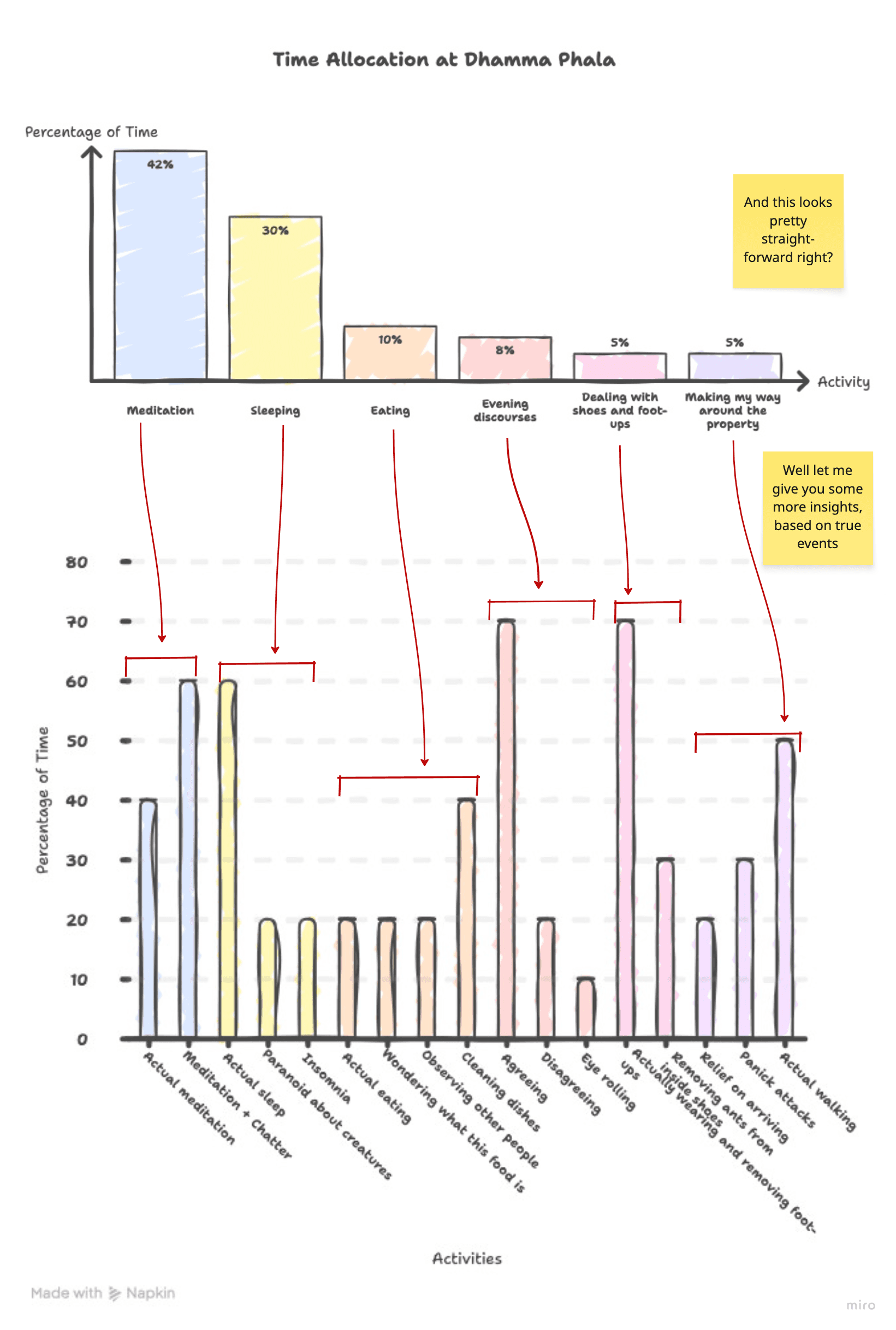
The meditation itself was intense. I had a lot of time to sit with all my emotions—who needs a phone or any entertainment if one has a mind like mine? I can be immersed in thoughts forever! And what were the emotions that I was experiencing from one day to the next? Glad you are interested:

So what was really happening? I can give more colour to the picture above:
Confusion about instructions:
Goenka Sir insisted, “Focus on bare breath; this is not a breathing exercise,” but I could sense nothing from the breathing?? Especially on the “small triangular area between your nose and upper lip.” Unless I took very heavy breaths, I could never “feel my breathing,” but constant heavy breathing turns this into a breathing exercise, no??
On Day 4, we were bombarded with actual Vipassana instructions: “Move your attention from the top of your head to the tips of your toes.” How?? How fast or slow should we go?? What are we looking for?? I didn't feel any sensation and I kept getting distracted. I had scanned my head, face, neck, and shoulders 17 times before losing track and having to start again. And I for sure didn't feel any sensation on my scalp... is everyone feeling these subtle sensations?? What are gross/solidified sensations?? What are blind spots?? Did I miss a lesson?
Skepticism:
Growing up, my grandparents were huge fans of a certain godman whose sermons we used to watch on TV. It was later discovered that the godman was a terrible human being, and this set a skepticism in my mind about Indian men giving spirituality discourses on TV. Turns out, this has stayed with me through all these years and was starting to get activated now. I found my mind rejecting the chanting and the random singing.
Then there was the exaggerated storytelling. He told a story about two beggar boys; one of them was blind since birth. The “normal” boy tries to describe Kheer to his friend. “It is white and so lovely!” The blind boy asks, “What is white??” The friend brings a white duck to his blind friend saying, “This is white.” The blind boy grabs the duck and says, “Oooh now I understand... white means soft!!!” Moral of the story: Develop your faculties, don’t be blind. I’m sorry, Sir, but why do you hate disabled children???
At some point, he said that one does not need as much sleep as they think they need—just meditate and you will feel fresh even if you only slept for five hours!! I don’t know about that, Sir; the Niki in my brain scoffed pretty heavily at this one.
Levels of Rage:
On the first day, I discovered that the dining hall was up a bunch of steps (minus handrails). Nothing drastic, but the first step was slightly higher than what I could manage to do even with the walking stick. Sometimes I could do it; sometimes I would almost lose balance and sometimes I would get stuck.
I named this step: Steve.
Steve is like the mid-level manager in a corporate setup. He is not high up enough to make any impact on your career, but he has the capacity to ruin your life day-to-day. Want to get the tech team to do a small ticket item? No ma'am, you don’t—first write a 10-pager on the impact. Want to make an app screen button black instead of purple?? No ma'am, first get the approval from Legal. This is Steve. We all know and dislike a Steve in our life. I spent the first three breakfasts and lunches crying silently because of Steve. I spent my initial nights fighting nightmare battles: Steve vs. Shtick
In general, there was quite a lot of anger at the whole “why me” of it all—anger at the inaccessibility, anger at Dhamma Phala, anger at the teacher, and anger at blah blah blah.
I noticed two ladies who would bring their thermoses for tea time and fill them up, leaving everyone else with less tea. It’s a good thing we had to maintain Noble Silence; this would have been a fight for sure. Why would they make a rat race out of tea time? How rude and inconsiderate.
I also noticed a tall white guy in the meditation hall wearing a pair of shorts. The guidelines were pretty clear, but of course, why would any rule apply to him, right?? Wow the rage.
Small victories:
Towards the end of Day 3, I discovered a slanting, tree-lined path next to the steps. It was covered with small plants but not impossible to walk on, especially with the help of the branches and of the trees. I immediately practiced going up and down that path a few times to confirm my feeling: I don’t need to deal with no Steves no more!
Another discovery: I remembered that back in my regular life, I used to do intermittent fasting. So I decided, I can just skip tea time. My last meal would be before noon and I would fast for 18 hours, but I would honestly prefer this to the tea-time rat race. This, plus avoiding Steve, gave me a lot of relief and a small sense of accomplishment.
Levels of Happiness:
On Day 4, I noticed that the girl who sat next to me for the meditations was missing the whole day and didn’t even show up for breakfast or lunch. A day later, it occurred to me that she might have left. To Cathleen, the lanky Filipino girl who was among the few to drop out of the course before she could start feeling any of the relief—I wish there was a way for me to send you hope; it does get better. Because it was on day 4 that I started recognizing some lightness.
I was so tired of being angry over the same things over and over again; it felt like chewing a huge wad of gum that had lost all flavor and was starting to hurt my mouth. How long will I chew? With the help of this tiredness, combined with the small sense of victory, I started to spit some of my anger out. Whatever anger I felt after this point had lost its initial lacklustre.
Initially, for a few days, I experienced my standard migraine episodes. On one of the days, I decided to experiment with the sensation. Goenka Sir kept mentioning that if you use your physical pain as a tool for developing equanimity, don’t identify with it, don't create an aversion to it, and please don’t treat it as a problem to be solved. I started to feel less sorry for myself and that also manifested as a big happiness.
On the 4th night, there was some karaoke going on in the outside world, the sound of which was faintly being carried into our 8:15 PM sitting. Some guy was singing “I Don’t Want to Miss a Thing” by Aerosmith. I found myself struggling to suppress a huge burst of laughter at how off-key but confident this guy was—I just had to give up on meditation that evening and instead just groove to the hint of a familiar song.
Relief, gratitude, and clarity:
Once I realized that the new waves of anger didn't have as much hold on me—that I now had tools to deal with them—I started feeling relief. In my normal life, I have very sure beliefs around people, usually based on an initial judgment. I was starting to realize that I was very wrong many times.
For example, what I assumed was a lack of compassion from Dhamma Phala with their email, I was now seeing as another act of compassion, just in a flavor that I did not recognize. No one can make the world more accessible for me; that is an unfortunate reality. But they wanted me to be warned, and when they saw that I was determined, they tried to make things easier by giving me my own room and a chair to sit on. Dhamma Phala didn't put Steve there to spite me; Steve is just a part of the world. My job wasn't to get derailed by Steve, but to find the tree-lined paths around him.
I think some people in my life are good at looking at a situation from various points of view. They can swap the puzzle pieces out and make for a more friendly big picture, whereas I have always had some unfriendly pieces that I try to fit onto every situation. I have empathy for myself in seeing the world that way, but I also have a strong realization now that this is my view, and I do have the potential to change it.
Now, before this section gets too preachy, I will wrap it up by saying that I had several crazy and powerful epiphenies after the first few days, and I am still unpacking many of them.
In Conclusion
I would say that my stay at Dhamma Phala was successful, even with all the difficulties—in fact, it feels like a bigger achievement because of the difficulties. In those 10 days, I learned a lot more about myself than I have over all these years. I had some pretty solid proof within the first few moments of being able to communicate with people that I was already able to see some improvements:
Ayurveda: As we got tea after our last meal together, one of the ladies approached me and asked about my condition. Halfway through my explanation of CMT, she dived into how Ayurveda had a solution for my exact problem and that I should definitely see this one doctor in Kerala. This is exactly the type of conversation that would usually evoke multiple negative reactions in me, but this time, I had only one thought: this lady comes from a place of compassion and I have no reason to correct her currently.
The real issue with my legs: Another lady grabbed hold of me while I was cleaning my dishes for the last time and mentioned with great conviction, “As you take a step forward, your past holds you back, and this is the reason why you have this hesitation in your step.” I gave her a hug and told her that I would keep her words in mind.
The "Brave" Man: As we did our group picture under the Bodhi tree of the centre, a man approached me and said: “You are a very brave lady; on the days I felt like I needed to quit, I would see that you are still here and told myself that if she can do it, what is my excuse?” I have never aspired to inspire. In fact, for most disabled people, "inspiration porn" is not cool (I urge you to read about it to get more context). I smiled and nodded, saying that I am glad I could help him in some way.

As I polish this story more than a month after the retreat, I can safely say that the practice is still somewhat with me—I have meditated in all kinds of odd spots, from airport gates to the backs of speeding taxis to slow boats between islands, and I am still benefiting from the practice tremendously.
Like Goenka Sir said: “If you would spend eight hours suffering over an incident before, this tool may help reduce your suffering by at least a few hours, and then those hours you gain may change everything for you!” This is exactly what I am experiencing. I may travel far, learn a lot, and eat even more new foods, make many cat and dog friends (or even human friends—looking at you here, Grace 😉), but this retreat may have been the most important trip I took this year.
Yesterday, Niki made a comparison between meditation and brushing teeth. He said that maybe the retreat is like a visit to the dentist; one goes for a deep cleaning, but upon returning, they still do need to brush twice a day to deal with the daily deposit of debris in order to maintain good hygiene. With this very accurate analogy, I close this very long chapter of Vipassana.
PS: In 2021, Raj and I went plant shopping—the only time we went together—and we bought one plant each, both the same variety of a special fern called the Phlebodium aureum—or the Blue Star Fern. However, mine sadly died within the first few months, and Raj’s kept thriving somehow. I was envious (and frankly surprised), but I accepted it. Five years later, at Dhamma Phala on one of my low days—Day 3—I noticed a small bush of that same fern growing right outside my room. Nowhere else on the property (I looked!!), and yet somehow outside my room, right out of the damn concrete. Take it as you will; I took it as a sign that my friend is somehow here, and is somehow finding a way to support me.


PPS: Because some of you might be wondering what Niki was up to for these 10 days, here is a video—and you will have to get the context from him directly! (yes those might be sharks) 🙂

And as always, we love you for being here <3
Next story


