

We arrived in Bangkok pretty late in the night of December 30th, 2025, just in time for celebrating NYE. We were now in fertile Mark Wiens territory and I came prepared (is what I thought). With more than a hundred spots marked on my map, we were on a mission.

Finding accommodation for the last two nights of the year was a challenge, so we settled on a "first-floor room, ground-floor bathroom" type of situation in the Dusit district. When we arrived at 64 Sweet Home, we were surprised to discover that the place was more a museum and less a living space. Since we were only there for two nights, we decided to marvel at the novelty of it all: every wall covered with religious posters, every floor space filled with artifacts probably acquired over many years (and for some reason, many owl statues). It was not a livable space for the faint of heart.
First thing on our agenda was to come up with a reasonable NYE plan: we ended up doing what was easiest and likely the most touristy thing to do, we took a cab to Khao San Road. Once again, it felt like a complete attack on the senses: with loud unappealing EDM blasting from all directions, every venue promising bottomless cocktail buckets and the best party of your life, street food vendors selling fried scorpions and grilled crocodile meat. I could see why the 20-somethings would flock here for a “good time”, but we were fully ready to take a U-turn 5 minutes in.
Just then we spotted something that stopped us in our tracks. Of all places, for some reason, a local cultural committee/group had organised the “Ramakien” play on the same street, as if to balance the nasty with some culture. This was completely unexpected, and I stood there mesmerized for 15 minutes, appreciating the music, the glittery costumes, dance, expressions, and how the drama felt so familiar but looked so different. The Ramakien is essentially a Thai adaptation of the Ramayana, with changes made to its characters, plot, and settings to better suit the cultural context of the Thai people. This obviously triggered my curiosity, and hence here are some fun facts I dug up (brought to you by my free Perplexity, you are welcome <3):
Ramayana is known as “Reamker” in Cambodia (depicted along the walls of Angkor Wat), “Maharadia Lawana” in the Philippines, “Kakawin Ramayana” in Indonesia and “Hikayat Seri Rama” in Malaysia.
In the Ramakien, Hanuman is charming, savvy, and has a trail of broken hearts across the kingdom (including a mermaid princess). If the Indian Hanuman ji is a bro-monk (devout, humble, and strictly celibate), the Thai Hanuman is the charismatic lead in a romantic comedy, who can also fight.
In the Ramakien, Thotsakan (Ravana) is portrayed with a massive amount of sympathy. He isn't just a "bad guy" doing bad things; he is often portrayed as a man deeply, obsessively in love. In the Thai version, his abduction of Sida (Sita) is framed more as a tragic, doomed romantic pursuit. Thai audiences often feel a "sweet sadness" for him, and his imagiry is part of local pop culture.
The Ramakien ignores the geography of India and sets the whole thing in a mythical version of Thailand. The characters are decked out in glittering Thai silk, pointed crowns, complete with iconic, beautiful masks.
Our plan was to find some food in the area and then head to another place for a more calm new year party. We did consider ICONSIAM for like 2 minutes, like every Instagram reel had suggested, but gut feeling said no. So at the corner of the street, we found some street vendors and a row of plastic stools, and we took it as our dinner cue. We ordered my type of food: one Tom Yum with instant ramen and our minds were absolutely blown! This was where I realized that:
Despite so many Thai food places being on our rotation in Berlin for our weekly cravings, I had never properly sat down and appreciated this dish enough. It's basically my fault for ignoring the 'Yum' in the name, and I will go on to correct this by eating a comical amount of Tom Yum.
I had a list of eating spots, sure, but it's very hard to beat the baseline excellence of food on the streets of Bangkok, no matter where you end up. For example, this place was not even listed on the map, and yet the flavours brought me so much satisfaction, portion size was great to share (and it did not make us sick).
After this meal, we walked to the Culture Cafe, for a cute and underground vinyl techno party. I was very grateful that we planned this bit, because being “out there” for NYE would have been a very bad decision: we read later that ICONSIAM had a serious cab shortage and people waited on the street till 5 in the morning 🤦♀️ all for 4 minutes of fireworks. And this way we ended up meeting cute new people like Jinjin!! (亲爱的吉金,若你正在读这封信,我们很庆幸能遇见你们二人,关于可持续性与快时尚的对话让我受益匪浅!期待有天重逢,共舞于美妙乐声之中!满满的爱与拥抱!❤️)

The first thing we did on the first day of 2026 was the thing I was most excited for: 7-Eleven. As soon as I stepped in, my inner voices started screaming: “Too many calories! Too much sugar!” But luckily, my curiosity is much louder than my negative self-talking “wannabe-ED” voice. I walked away with a balanced assortment of protein shakes and some viral snacks. “Add, don’t remove” and “all things in moderation” will be the only way to survive Thailand without any major regrets.

This week, we ate like kings. I want to remember every morsel, and without boring you too much, I will make a short unranked list of the highlights: readers who identify as “non-foodies” can skip ahead (to what I don’t know, I don’t have much to offer to the smarter ones who don’t live to eat) 🫡
Congee: Pae’s Brass Pot Congee is a small shop holding a Michelin Bib Gourmand, and located in Bang Sue, significant for its Thai-Chinese community. The shop has been operating for over 60 years, currently managed by the third generation of the family. I learned that in the early days, the grandfather could not afford professional equipment, so he reportedly fashioned his first cooking pot from scraps of discarded warship propellers. Currently they prepare their congee in custom brass (bronze) pots, slow cooking jasmine rice in bone broth until it's silky, topping it off with hand-minced meat. We garnished with Aunty’s fresh mango chilli salsa along with the typical Chinese chilli oil, and the result was a breakfast I can imagine burning my tongue to every morning.

Big Su: This noodle shop was Niki’s find, and has been a fixture in the Ratchawat neighborhood (where we stayed for the first two days) for nearly 70 years, famous for being the "unofficial mess hall" for high-ranking Thai Army personnel and government officials whose offices are located nearby. Their broth is a Nam Tok (dark) style, characterized by a Chinese medicinal herb base, simmered for a minimum of 6 hours before the first bowl is served. Key aromatics include star anise, cinnamon, and goji berries, creating a balanced savory-sweet profile that is rich but not oily. We reached the shop one minute before noon, beating the lunch line by a small narrow margin. Later I read that these folks run out of food pretty quickly, and for good reason.
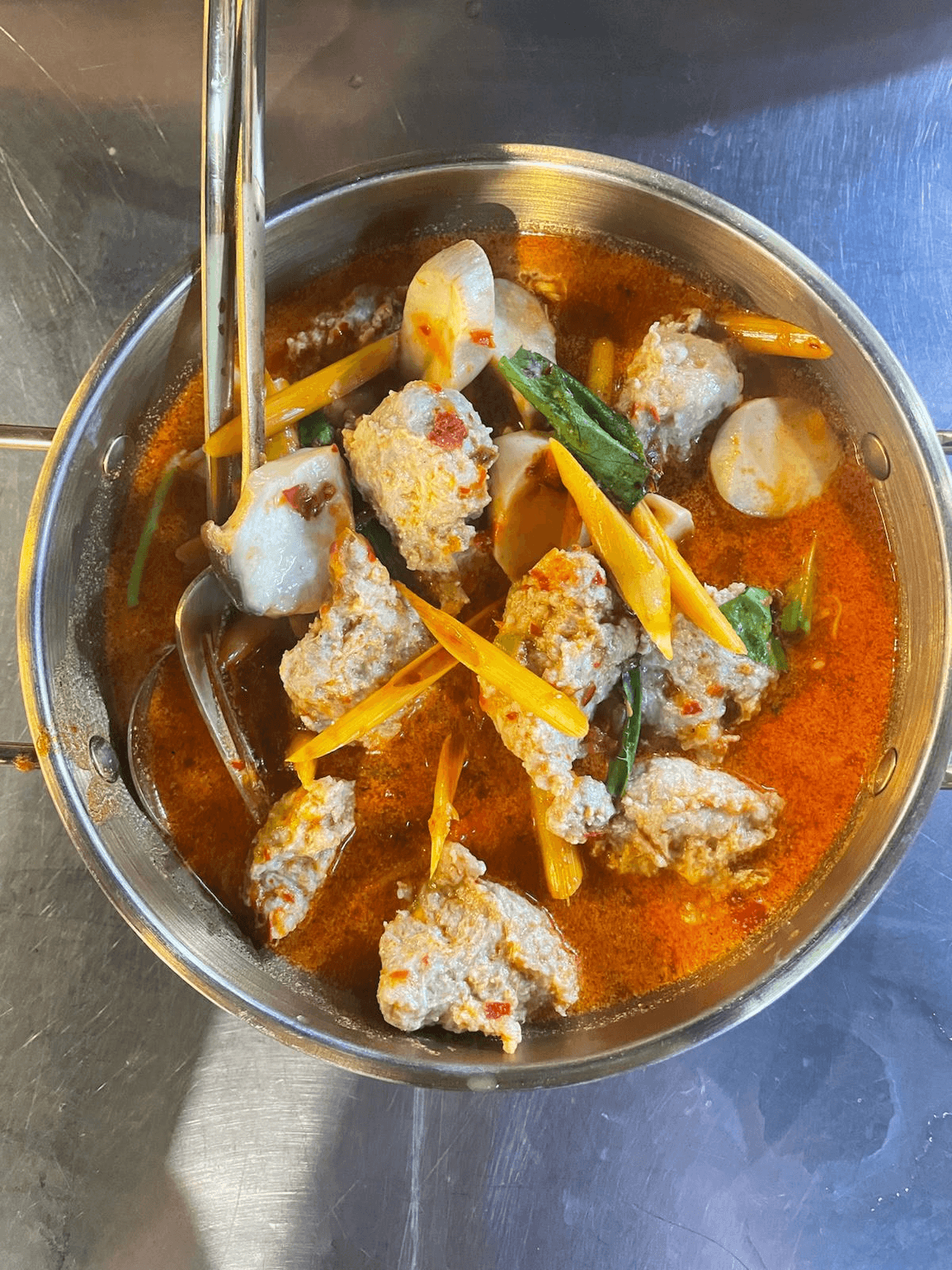
Chef Gaa Moo Krob: Another one of Niki’s find, through our favorite food researchers on YouTube - OTR. They described Chef Gaa as one of the best chefs (that no one knows about) in Bangkok: and that is a very tall claim, taking Chef Gaa to cult-like status within the Bangkok food seeking community. To say that the establishment is “modest”, would be a joke. Chef Gaa’s “restaurant” is essentially a window from a run down shophouse, located in a slum area of Bang Sue. There is only enough space for two people to be seated in front of his wok, where he individually prepares the requested food from a menu of 4 items 😳. A word of warning for the more cautious amongst us, this is what netizens had to say about the neighbourhood:
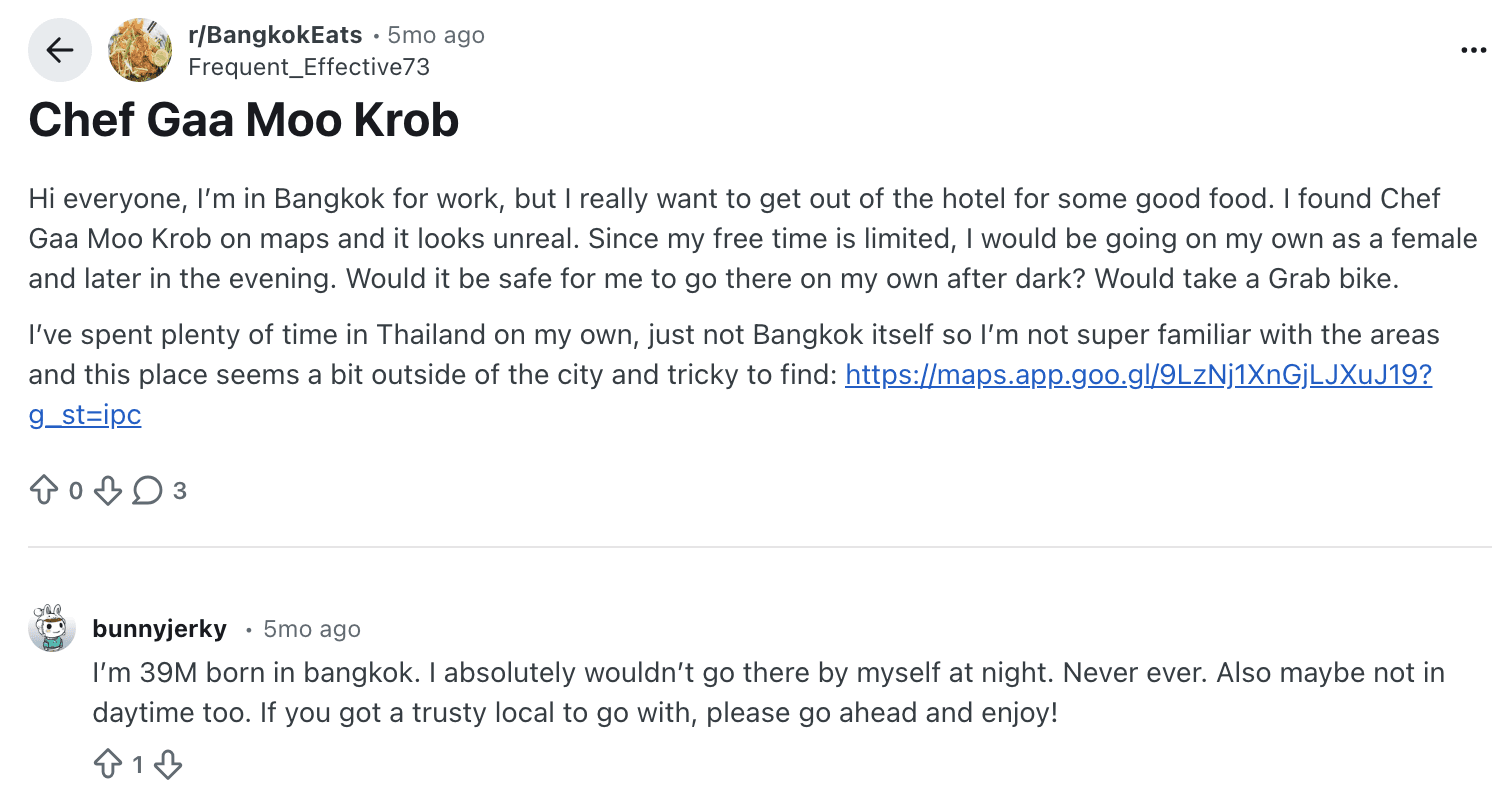
I am still congratulating us for managing to eat what turned out to be one of the finest meals of our lives. If we get a chance, we would 100% visit again, but this time hopefully during the daytime and with more people.

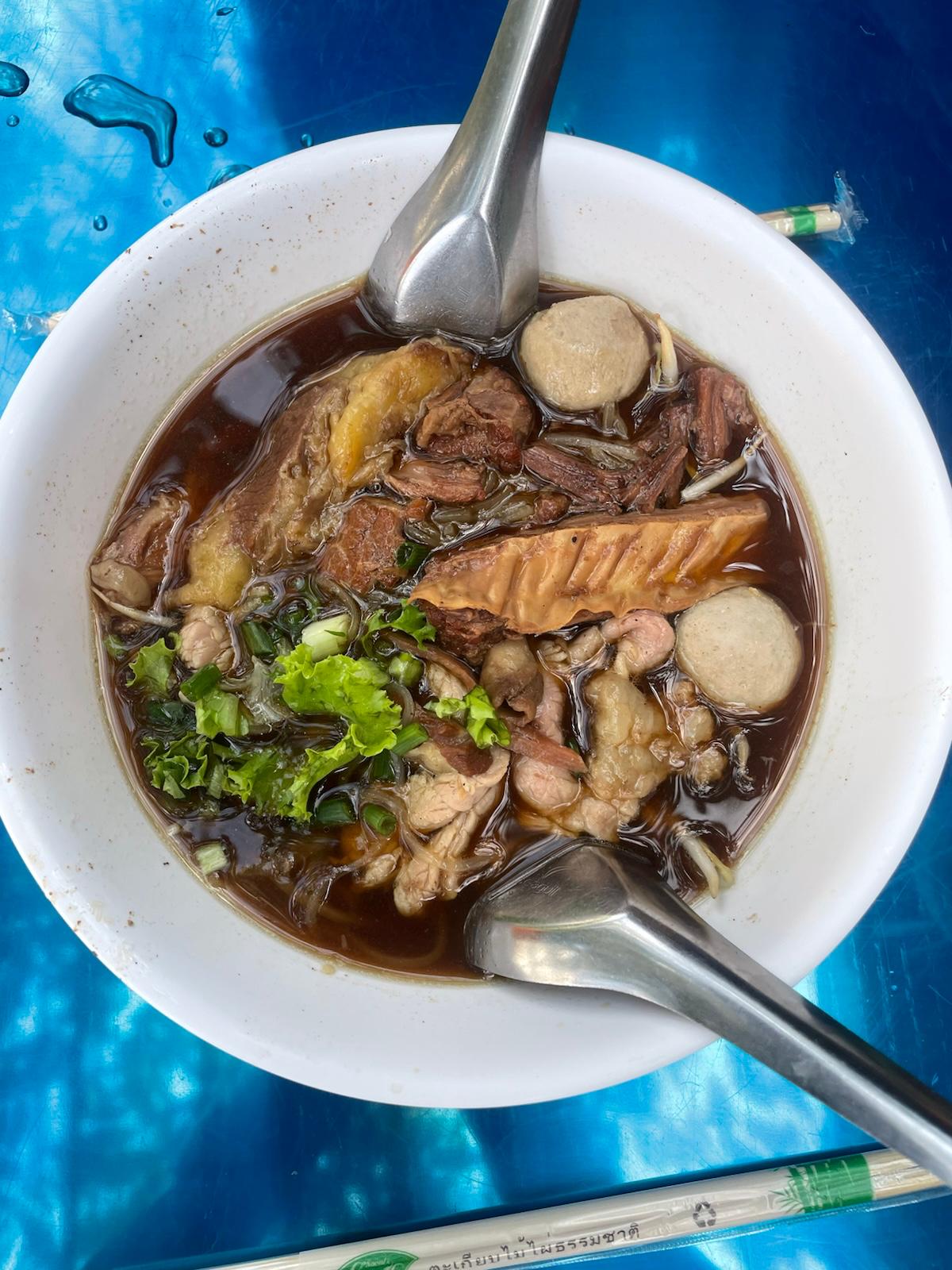
Auntie’s boat noodles: Boat noodles were traditionally sold by vendors on small canoes in the canals of Bangkok and Ayutthaya. Because the vendors had to paddle, cook, and serve from a wobbly boat, the bowls were kept tiny, the soup levels low and it came pre-seasoned (with salt, vinegar and chili). In the 1970s, as Bangkok’s canals were paved over to make way for roads, these vendors moved into permanent shophouses. The cluster at Victory Monument (along the Khlong Samsen canal) became the most famous hub for these noodles. While many shops exist, they are often referred to collectively as "Auntie's noodles" because the industry was historically dominated by female matriarchs who (very competitively) managed the complex broth recipes. This was pretty high up on my list for at least a few years, recommended by every blogger, vlogger and food influencer, and it did not disappoint!

Jack’s chicken rice: I found this one through Doobiedoobap <3 this is another cult-favorite institution located in Bangkok’s Phra Nakhon (Old Town) district, an area famous for "Cook Shops"—restaurants opened by Hainanese immigrants who worked as chefs for Westerners or the Thai elite during the early 20th century. I learned that while commonly referred to as "Jack’s" by travelers and food bloggers, the shop is locally known as Jek Chuea. "Jek" is a Thai-Chinese honorific for an uncle or middle-aged man of Chinese descent. Hainanese chicken rice or “Khao Man Gai” as it is known in Thailand, has also been on my list for ages. I was always curious because how can a beige looking boiled chicken on rice be as popular as it is? I was very right to be curious and very wrong to underestimate this very complex dish, prepared with a lot of technique and packing a big flavor punch.

Amin mutton and chicken biriyani: This was another spot highlighted in almost every list: Mark Wiens cited it as a “Bangkok-must-eat”, Doobiedoobap called their goat curry “one of her favorite bites in Bangkok”, OTR described it as what might be his “favorite place for lunch- in the world”, and the Culinary Backstreets described them as the “embodiment of the soul of Bangkok’s Thai-Muslim community“. Naturally we were here at 8 am one morning, requesting Biryani for breakfast. While the Indian biryani relies heavily on fragrant (and much easier to prepare) Basmati rice, a wide array of whole spices, and often features a significant "chili heat" and “ghee aroma”, Thai biryani sets itself apart by using jasmine rice, fewer spices, cooked in rendered fat, and served with Green Mint and Cilantro chutney as well as their very tangy clear broth. Paired with the Thai-Muslim style goat curry and masaman curry, this meal was fighting pretty hard for our number one spot.

Shakes, snacks and sweets: evenings would usually be reserved for night market crawls across Bangkok: we managed to cover Chatuchak, Train night market, Asiatique and Chinatown. Our philosophy was pretty simple: always stop where the smells and aromas force you to stop, or if one of us sees anything interesting or familiar from research, order one dish per stop, carry enough cash, and always oscillate between sweet and savoury. And of course always have a drink handy to wash everything down. We ate everything: from curry puffs to endless helpings of mango sticky rice, from pork toasties to coconut shakes, from sausages from the North of Thailand to oyster omelettes from the south of China. The list was endless and we soldiered on without any major (metaphorical or literral) hiccups. Only on one occasion I sensed my stomach complaining, and luckily 7-Elevens are well stocked with solutions for this exact situation.

We were in Bangkok for just one week, and during this week, most restaurants on our list (including Mark Wiens’ “Phed Mark” 😞) were shut down due to the New Year. Can you believe that we still managed to eat as much as we did? Part of the reason was that we had our eyes and ears peeled for any specialty dish. On one such occasion, when we found a duck noodle place on our list closed, our Grab driver guided us to a local favorite for the same type of noodles.

Oh and we also visited Wat Phra Kaew (Grand Palace), Wat Pho (Reclining Buddha) at some points in between. The Grand Palace is a massive, shimmering complex where every square inch is covered in gold leaf or mosaics, centered around the small but spiritually massive Emerald Buddha. Walking through it feels like being inside a giant, open-air jewelry box, and the outer walls are lined with a continuous 2-kilometer mural of the Ramakien. Wat Pho houses a 46-meter long gold-plated Buddha—that the temple building feels like it’s barely containing him. Beyond the statue, the grounds serve as the historic birthplace of Thai massage. No, I have not inserted this paragraph in hindsight because this story featured only the foods we ate. Listen: we went to Bangkok for the food. Temples were nice and gorgeous palate cleansers.

Notable things about Bangkok that made my jaw drop:
Hyper-specialized food culture: We went to places that have been in business for more than 50 years, honing and specializing single dishes. In Thailand, "mastery of the specific" is a higher social currency than "variety," creating a landscape where a humble street stall can hold a Michelin star purely for its technical precision with a single ingredient.
“Beautiful Streets in 50 Districts” policy: We were likely just in time to see the first results from some city improvements: the city upgraded its drainage systems specifically to prevent wastewater from discharging onto sidewalks. This plus the revitalization of canals likely transformed once-polluted waterways into clean, pedestrian-friendly "hipster havens," significantly reducing the typical tropical city street scents. I also noticed that while most street foods were selling seafood and meat, all the melting ice from meats and fish on display was collected via water pipes and drained in a proper way (and not made to drip on the street causing unpleasantness).
Cut fruit culture: Thailand has ruined us for life I am afraid. Since then, we have been searching for the same cut fruit culture in every new city we visit, but it's hardly ever the same. From rose apples to miniature pineapples, all fresh and with the exactly correct balance between texture, flavor and juiciness. I later read that this was also an initiative of the Thai government, called the “2025 Fruit Management Measure,” promoting the "fruit cart economy" to ensure that premium-grade fruits are redistributed from farms to city corners within 24 hours 🤩. There was a fruit cart below the metro station nearest to our Sukhumvit apartment, and in our short stay, those fruit sellers knew us enough to start cutting as soon as they saw us approaching.
The public transport system—specifically the BTS (Skytrain) and MRT (Subway)—of course the connectivity was not as excellent as what we may be used to in Berlin, but it still brought a lot of efficiency to our food crawl.
Move over Paris, Gen Z fashion clearly belongs to the Thai. On our many trips around the city (especially using public transport) I would often notice the college kids dressed in "T-Pop" and K-pop-infused styles that prioritized luxury streetwear and "genderless" fashion. I felt like an ugly old man next to these live runway models. 🤦♀️
With this, I will close the Bangkok chapter, but the next one will be a complete change of scenery, where Niki and I get to live in a version of the dream life. I am very excited to bring it to you 🙂
We love you for sticking around!

Next story


